
Shirly Moas at the clinic
A private clinic

A space for all
your versions

Individual, couples and relationship therapy, teens and parents.

Book an introductory session

“It matters to me to create a safe, non-judgmental space for every person and every form of relationship. A place where we can look at ourselves and our relationships from more angles, and discover that there is more than one way to go on.”

Shirly Moas
InfidelityA breach of the agreements, explicit or implied, between partners. There is no single list of acts that count as infidelity: for one couple a secret emotional bond, messaging or a dating app is infidelity, and for another it is not. The precise question is not only what happened, but what was agreed and what was hidden.Repair after hurtAn attempt to restore connection and security by acknowledging what happened, listening to its impact, taking responsibility and changing behavior. An apology can be part of repair, but on its own it is not enough.Avoidant attachmentA tendency to feel less comfortable leaning on a partner emotionally. When closeness or tension rises, the person may downplay their need for support, close off or take distance. This does not mean they do not want a relationship, and not every request for space reflects this pattern. It is a tendency on a continuum, not a diagnosis or a fixed trait.Emotional floodingHigh emotional and physical arousal during conflict that makes it hard to listen, think and hold a conversation. A pause can help, if it is agreed on and ends with a return to the conversation.NarcissismA term for traits of self-focus, a need for admiration or a sense of entitlement, which exist in many people to varying degrees. Narcissistic personality disorder is a separate clinical diagnosis that only a professional can make, and it cannot be inferred from a fight, a single hurtful behavior or an online description. It is better to describe the behavior and its impact than to diagnose.Bids for connectionSmall, everyday attempts to get attention, closeness or a response, such as a remark, a question, a touch or a joke. How a partner responds, by turning toward them or ignoring them, affects the sense of closeness in the relationship.Coming outThe process of sharing one's sexual orientation or gender identity with others. It is not a single event but something that recurs throughout life, with every new person or place.

A space for therapy and change

Individual therapy

Getting to know yourself differently

Sometimes it is anxiety, a crisis, a past experience that keeps having an effect, or a difficulty that repeats in relationships. And sometimes it is a sense that something in life no longer fits us the way it used to. In therapy we can understand what is on your mind, recognize patterns that repeat, and explore more ways to cope and to choose.

Couples and relationship therapy

Closeness and freedom in the same relationship

Even when we love, being together is not always simple. Sometimes the years go by and, without noticing, partners become co-managers of a shared life. Sometimes it is a gap in desires, difficulties with intimacy, jealousy, infidelity or a crisis of trust. In therapy we can understand what is happening between you, what each of you is asking of the relationship, and how you want to go on from here.

Teens and parents

Growing up in a world that changes faster than us

In adolescence, teenagers explore different versions of themselves. Friendships change, boundaries are tested, and questions of identity, gender, sexuality and belonging take on new meaning. Alongside these come anxiety, insecurity, social difficulties or tension at home.

As parents, we know our children, but not always the world they are growing up in. It is not always clear when to come closer, when to set a limit and when to allow independence. I accompany teenagers in what is on their minds, and parents in keeping the connection and remaining a secure base to return to, even when they do not understand everything.
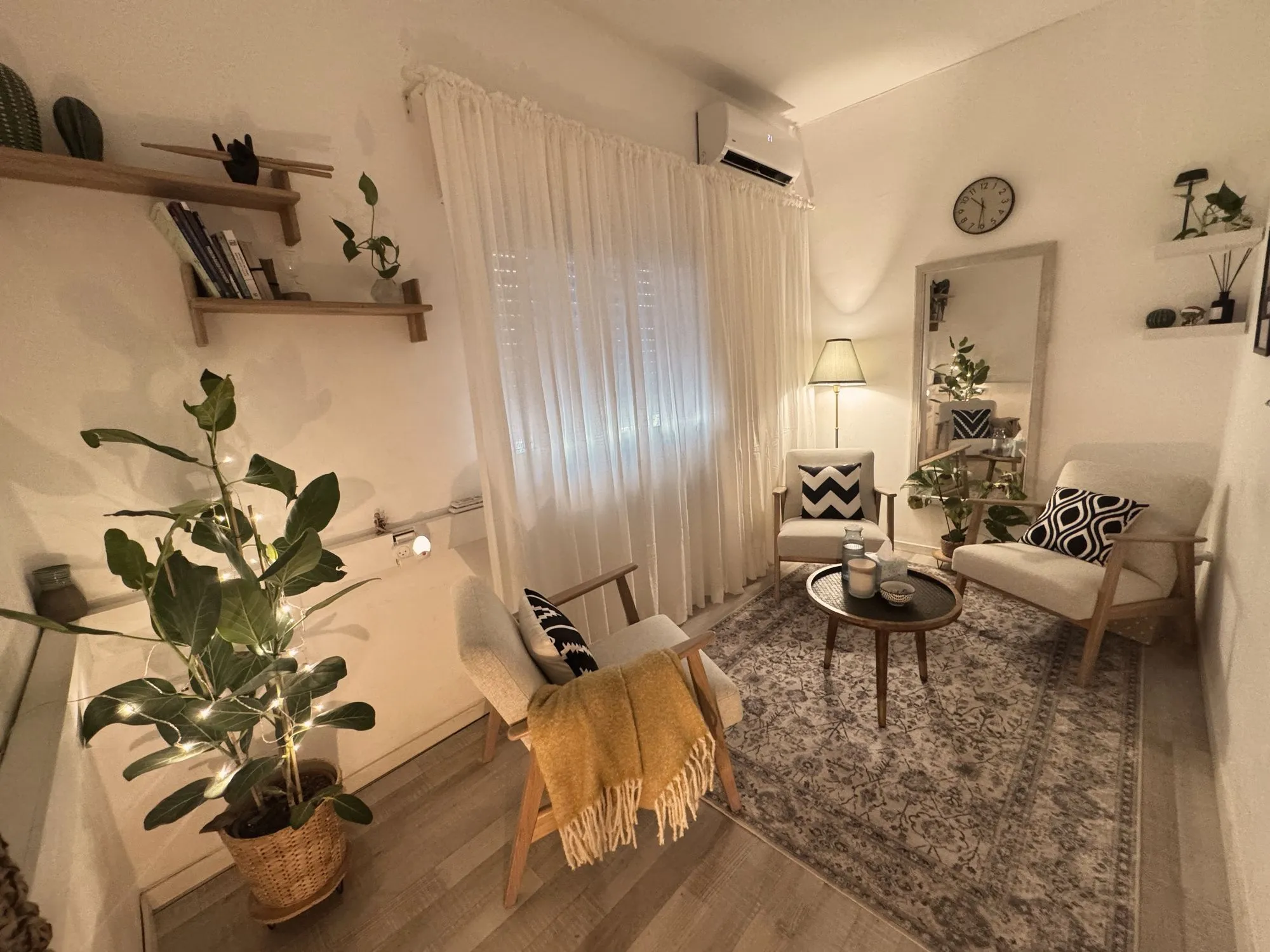
The therapy room at the clinic

The clinic and the therapeutic approach

In the clinic we work on what is on your mind now, and on what keeps coming back, like an argument that always unfolds the same way, or a feeling that returns in every relationship. Once the pattern is clearly seen, it can begin to change, and sometimes that starts with a small step tried between sessions.

The first meeting is a getting to know each other. There is no need to arrive with a precise definition of the problem; we will find the words together.

A friendly clinic

The clinic is open to every identity, sexual orientation and form of relationship: the LGBTQ+ community, monogamy and non-monogamy, polyamory, kink and BDSM. Here you can speak openly about relationships, sexuality, desires and boundaries.

Let’s start with a conversation.

A few words about what brings you are enough.
From there, we will set up a first meeting together.

This channel is for scheduling only, so there is no need to share sensitive personal details. In an emergency in Israel: ERAN 1201 or MDA 101.

Privacy policy

Draft for a lawyer's review before launch.

What is collected

Only what you choose to send: a name and a way to reach you, and an email address if you subscribe to the letter.

What it is used for

To reply to you, and to send the letter if you asked for it. Nothing is sold or passed on for marketing.

Where it is kept

Inquiries reach Shirly's mailbox. Subscriptions are kept with the service that sends the letter. The services will be named here before launch.

Your rights

You can ask to see, correct or delete your details at any time: contact@shirlymoas.com.

Cookies

The site does not use tracking or measurement cookies. If that changes, you will be asked for consent first.

Accessibility statement

Draft. Compliance is confirmed only after an accessibility check before launch.

The site is built to be accessible to people with disabilities, following Israeli standard IS 5568 and WCAG 2.1 at level AA.

What was done

  • Full keyboard navigation with a visible focus state and a skip to content link
  • Sufficient contrast and readable text
  • Text descriptions for images
  • Labelled form fields
  • Marked headings and page regions for screen reader navigation
  • Reduced motion for visitors who ask for it

Accessibility menu

An accessibility button sits in the bottom corner of the screen. It lets you enlarge text in two steps, switch on high contrast, highlight links, stop animations and switch to a readable font. Settings are saved in your browser for your next visit, and the reset button restores the default view.

Testing

The site was tested with the automated axe-core checker on every page, at desktop and mobile widths, and fixed according to the findings. Automated testing does not replace a full manual review, so compliance will be confirmed in the accessibility check before launch.

Found a problem?

Accessibility coordinator: Shirly Moas, contact@shirlymoas.com. Last updated: [launch date].

Terms of use

Draft for a lawyer's review before launch.

Not a substitute for care

The content here is general. It is not therapy, diagnosis or professional advice for any specific person. In an emergency, contact emergency services.

Content

The texts, ideas and images belong to Shirly Moas. Quoting with credit and a link is welcome; other uses need permission.

Contact through the site

Sending a form does not create a therapeutic relationship.